
1)预定义函数对象基本概念:标准模板库STL提前定义了很多预定义函数对象,#include <functional> 必须包含。
//1使用预定义函数对象:
//类模板plus<> 的实现了: 不同类型的数据进行加法运算
void main()
{
    plus<int> intAdd;
    int x = 10;
    int y = 20;
    int z = intAdd(x, y); //等价于 x + y
    cout << z << endl;

    plus<string> stringAdd;
    string myc = stringAdd("aaa", "bbb");
    cout << myc << endl;

    vector<string> v1;
    v1.push_back("bbb");
    v1.push_back("aaa");
    v1.push_back("ccc");
    v1.push_back("zzzz");

    //缺省情况下,sort()用底层元素类型的小于操作符以升序排列容器的元素。
    //为了降序,可以传递预定义的类模板greater,它调用底层元素类型的大于操作符:
    cout << "sort()函数排序" << endl;;
    sort(v1.begin(), v1.end(), greater<string>() ); //从大到小
    for (vector<string>::iterator it=v1.begin(); it!=v1.end(); it++ )
    {
        cout << *it << endl;
    }
}
2)算术函数对象
预定义的函数对象支持加、减、乘、除、求余和取反。调用的操作符是与type相关联的实例加法:plus<Types>
plus<string> stringAdd;
sres = stringAdd(sva1,sva2);
减法:minus<Types>
乘法:multiplies<Types>
除法divides<Tpye>
求余:modulus<Tpye>取反:negate<Type>
negate<int> intNegate;
ires = intNegate(ires);
Ires= UnaryFunc(negate<int>(),Ival1);
3)关系函数对象
等于equal_to<Tpye>
equal_to<string> stringEqual;
sres = stringEqual(sval1,sval2);
不等于not_equal_to<Type>
大于 greater<Type>
大于等于greater_equal<Type>
小于 less<Type>
小于等于less_equal<Type>
void main()
{
    vector<string> v1;
    v1.push_back("bbb");
    v1.push_back("aaa");
    v1.push_back("ccc");
    v1.push_back("zzzz");
    v1.push_back("ccc");
    string s1 = "ccc";
    //int num = count_if(v1.begin(),v1.end(), equal_to<string>(),s1);
    int num = count_if(v1.begin(),v1.end(),bind2nd(equal_to<string>(), s1));
    cout << num << endl;
}
4)逻辑函数对象
逻辑与 logical_and<Type>
logical_and<int> indAnd;

ires = intAnd(ival1,ival2);

dres=BinaryFunc( logical_and<double>(),dval1,dval2);
逻辑或logical_or<Type>
逻辑非logical_not<Type>
logical_not<int> IntNot;

Ires = IntNot(ival1);

Dres=UnaryFunc( logical_not<double>,dval1);
函数适配器
1)函数适配器的理论知识
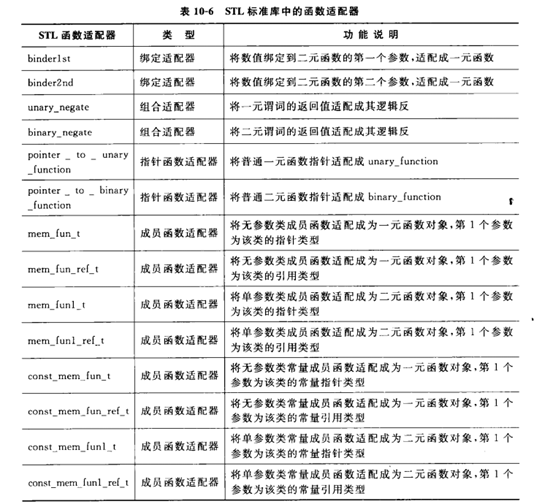


2)常用函数函数适配器
标准库提供一组函数适配器,用来特殊化或者扩展一元和二元函数对象。常用适配器是:
1绑定器(binder): binder通过把二元函数对象的一个实参绑定到一个特殊的值上,将其转换成一元函数对象。C++标准库提供两种预定义的binder适配器:bind1st和bind2nd,前者把值绑定到二元函数对象的第一个实参上,后者绑定在第二个实参上。
2取反器(negator) : negator是一个将函数对象的值翻转的函数适配器。标准库提供两个预定义的ngeator适配器:not1翻转一元预定义函数对象的真值,而not2翻转二元谓词函数的真值。
常用函数适配器列表如下:
bind1st(op, value)
bind2nd(op, value)
not1(op)
not2(op)
mem_fun_ref(op)
mem_fun(op)
ptr_fun(op)
例子:
class IsGreat
{
public:
    IsGreat(int i)
    {
        m_num = i;
    }
    bool operator()(int &num)
    {
        if (num > m_num)
        {
            return true;
        }
        return false;
    }
protected:
private:
    int m_num;
};

void main()
{
    vector<int>  v1;
    for (int i=0; i<5; i++)
    {
        v1.push_back(i+1);
    }

    for (vector<int>::iterator it = v1.begin(); it!=v1.end(); it ++)
    {
        cout << *it << " " ;
    }

    int num1 = count(v1.begin(), v1.end(), 3);
    cout << "num1:" << num1 << endl;

    //通过谓词求大于2的个数
    int num2 = count_if(v1.begin(), v1.end(), IsGreat(2));
    cout << "num2:" << num2 << endl;

    //通过预定义函数对象求大于2的个数   greater<int>() 有2个参数
    //                                                param > 2
    int num3 = count_if(v1.begin(), v1.end(), bind2nd(greater<int>(), 2 ) );
    cout << "num3:" << num3 << endl;

    //取模 能被2整除的数 求奇数
    int num4 = count_if(v1.begin(), v1.end(), bind2nd(modulus <int>(), 2 ) );
    cout << "奇数num4:" << num4 << endl;

    int num5 = count_if(v1.begin(), v1.end(), not1( bind2nd(modulus <int>(), 2 ) ) );
    cout << "偶数num5:" << num5 << endl;
    return ;
}
STL的容器算法迭代器的设计理念
1) STL的容器通过类模板技术,实现数据类型和容器模型的分离
2) STL的迭代器技术实现了遍历容器的统一方法;也为STL的算法提供了统一性奠定了基础
3) STL的算法,通过函数对象实现了自定义数据类型的算法运算;所以说:STL的算法也提供了统一性。
核心思想:其实函数对象本质就是回调函数,回调函数的思想:就是任务的编写者和任务的调用者有效解耦合。函数指针做函数参数。
4) 具体例子:transform算法的输入,通过迭代器first和last指向的元算作为输入;通过result作为输出;通过函数对象来做自定义数据类型的运算。、
来源:https://www.cnblogs.com/gd-luojialin/p/9783625.html