
问题
I would like to deconvolve a 2D image with a point spread function (PSF). I've seen there is a scipy.signal.deconvolve function that works for one-dimensional arrays, and scipy.signal.fftconvolve to convolve multi-dimensional arrays. Is there a specific function in scipy to deconvolve 2D arrays?
I have defined a fftdeconvolve function replacing the product in fftconvolve by a divistion:
def fftdeconvolve(in1, in2, mode="full"):
    """Deconvolve two N-dimensional arrays using FFT. See convolve.

    """
    s1 = np.array(in1.shape)
    s2 = np.array(in2.shape)
    complex_result = (np.issubdtype(in1.dtype, np.complex) or
                      np.issubdtype(in2.dtype, np.complex))
    size = s1+s2-1

    # Always use 2**n-sized FFT
    fsize = 2**np.ceil(np.log2(size))
    IN1 = fftpack.fftn(in1,fsize)
    IN1 /= fftpack.fftn(in2,fsize)
    fslice = tuple([slice(0, int(sz)) for sz in size])
    ret = fftpack.ifftn(IN1)[fslice].copy()
    del IN1
    if not complex_result:
        ret = ret.real
    if mode == "full":
        return ret
    elif mode == "same":
        if np.product(s1,axis=0) > np.product(s2,axis=0):
            osize = s1
        else:
            osize = s2
        return _centered(ret,osize)
    elif mode == "valid":
        return _centered(ret,abs(s2-s1)+1)
However, the code below does not recover the original signal after convolving and deconvolving:
sx, sy = 100, 100
X, Y = np.ogrid[0:sx, 0:sy]
star = stats.norm.pdf(np.sqrt((X - sx/2)**2 + (Y - sy/2)**2), 0, 4)
psf = stats.norm.pdf(np.sqrt((X - sx/2)**2 + (Y - sy/2)**2), 0, 10)

star_conv = fftconvolve(star, psf, mode="same")
star_deconv = fftdeconvolve(star_conv, psf, mode="same")

f, axes = plt.subplots(2,2)
axes[0,0].imshow(star)
axes[0,1].imshow(psf)
axes[1,0].imshow(star_conv)
axes[1,1].imshow(star_deconv)
plt.show()
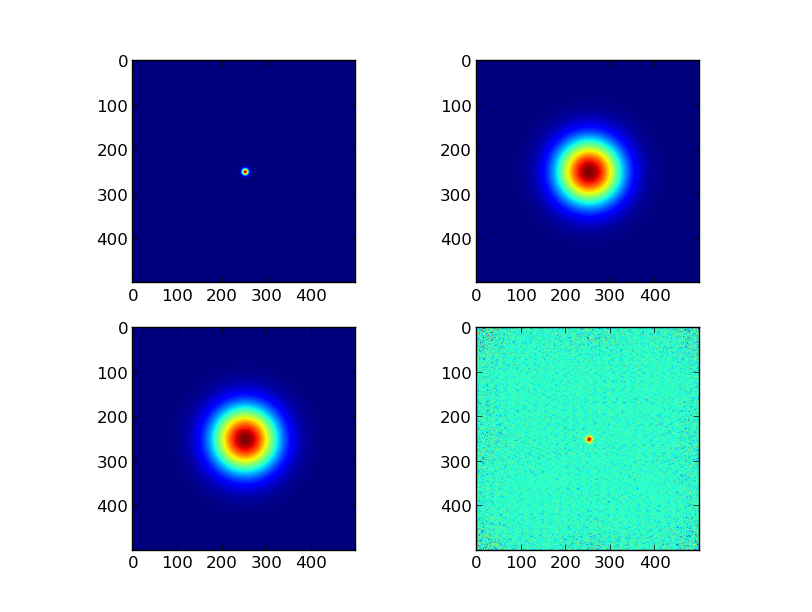
The resulting 2D arrays are shown in the lower row in the figure below. How could I recover the original signal using FFT deconvolution?

回答1:
These functions using fftn, ifftn, fftshift and ifftshift from the SciPy's fftpack package seem to work:
from scipy import fftpack

def convolve(star, psf):
    star_fft = fftpack.fftshift(fftpack.fftn(star))
    psf_fft = fftpack.fftshift(fftpack.fftn(psf))
    return fftpack.fftshift(fftpack.ifftn(fftpack.ifftshift(star_fft*psf_fft)))

def deconvolve(star, psf):
    star_fft = fftpack.fftshift(fftpack.fftn(star))
    psf_fft = fftpack.fftshift(fftpack.fftn(psf))
    return fftpack.fftshift(fftpack.ifftn(fftpack.ifftshift(star_fft/psf_fft)))

star_conv = convolve(star, psf)
star_deconv = deconvolve(star_conv, psf)

f, axes = plt.subplots(2,2)
axes[0,0].imshow(star)
axes[0,1].imshow(psf)
axes[1,0].imshow(np.real(star_conv))
axes[1,1].imshow(np.real(star_deconv))
plt.show()
The image in the left bottom shows the convolution of the two Gaussian functions in the upper row, and the reverse of the effects of convolution is shown in the bottom right.
回答2:
Note that deconvolving by division in the fourier domain isn't really useful for anything but demonstration purposes; any kind of noise, even numerical, may render your outcome completely unusable. One may regularize the noise in various ways; but in my experience, an RL iteration is easier to implement, and in many ways more physically justifiable.
来源:https://stackoverflow.com/questions/17473917/is-there-a-equivalent-of-scipy-signal-deconvolve-for-2d-arrays