
题目来源
最大流
最大流问题是网络流的经典类型之一,用处广泛,个人认为网络流问题最具特点的操作就是建反向边,这样相当于给了反悔的机会,不断地求增广路的,最终得到最大流


#include<iostream>
#include<cstdio>
#include<algorithm>
#include<cstring>
#include<queue>
#include<string>
#include<fstream>
#include<vector>
#include<stack>
#include <map>
#include <iomanip>
#define bug cout << "**********" << endl
#define show(x,y) cout<<"["<<x<<","<<y<<"] "
//#define LOCAL = 1;
using namespace std;
typedef long long ll;
const int inf = 0x3f3f3f3f;
const ll mod = 1e6 + 3;
const int Max = 1e5 + 10;

struct Edge {
    int to, next, flow;    //flow记录这条边当前的边残量
}edge[Max << 1];


int n, m, s, t;
int head[Max], tot;
bool vis[Max];

void init()
{
    memset(head, -1, sizeof(head));tot = 0;
}

void add(int u, int v, int flow)
{
    edge[tot].to = v;
    edge[tot].flow = flow;
    edge[tot].next = head[u];
    head[u] = tot++;
}

//向图中增加一条容量为exp的边(增广路)
int dfs(int u,int exp)
{
    if (u == t) return exp;            //到达汇点,当前水量全部注入
    vis[u] = true;                    //表示已经到了过了
    for(int i = head[u] ; i != -1  ;i = edge[i].next)
    {
        int v = edge[i].to;
        if(!vis[v] && edge[i].flow > 0)
        {
            int flow = dfs(v, min(exp, edge[i].flow));
            if(flow > 0)            //形成了增广路
            {
                edge[i].flow -= flow;
                edge[i ^ 1].flow += flow;
                return flow;
            }

        }

    }
    return 0;                        //无法形成增广路的情况
}

//求最大流
int max_flow()
{
    int flow = 0;
    while(true)
    {
        memset(vis, 0, sizeof(vis));
        int part_flow = dfs(s, inf);
        if (part_flow == 0) return flow;
        flow += part_flow;
    }
}


int main()
{
#ifdef LOCAL
    freopen("input.txt", "r", stdin);
    freopen("output.txt", "w", stdout);
#endif
    while (scanf("%d%d%d%d", &n, &m, &s, &t) != EOF)
    {
        init();
        for (int i = 1, u, v, flow;i <= m; i++)
        {
            scanf("%d%d%d", &u, &v, &flow);
            add(u, v, flow);add(v, u, 0);
        }
        printf("%d\n", max_flow());
    }

    return 0;
}
#include<iostream>
#include<cstdio>
#include<algorithm>
#include<cstring>
#include<queue>
#include<string>
#include<fstream>
#include<vector>
#include<stack>
#include <map>
#include <iomanip>
#define bug cout << "**********" << endl
#define show(x,y) "["<<x<<","<<y<<"]"
//#define LOCAL = 1;
using namespace std;
typedef long long ll;
const int inf = 0x3f3f3f3f;
const ll mod = 1e6 + 3;
const int Max = 1e5 + 10;

struct Edge {
    int to, next, flow;    //flow记录这条边当前的边残量
}edge[Max << 1];


int n, m, s, t;
int head[Max], tot;
int dis[Max];

void init()
{
    memset(head, -1, sizeof(head));tot = 0;
}

void add(int u, int v, int flow)
{
    edge[tot].to = v;
    edge[tot].flow = flow;
    edge[tot].next = head[u];
    head[u] = tot++;
}

bool bfs() //判断图是否连通
{
    queue<int>q;
    memset(dis, -1, sizeof(dis));
    dis[s] = 0;
    q.push(s);
    while (!q.empty())
    {
        int u = q.front();q.pop();
        for (int i = head[u]; i != -1; i = edge[i].next)
        {
            int v = edge[i].to;
            if (dis[v] == -1 && edge[i].flow > 0)        //可以借助边i到达新的结点
            {
                dis[v] = dis[u] + 1;                    //求顶点到源点的距离编号
                q.push(v);
            }
        }
    }
    return dis[t] != -1;                                //确认是否连通
}

int dfs(int u, int flow_in)
{
    if (u == t) return flow_in;
    int flow_out = 0;                                    //记录这一点实际流出的流量
    for (int i = head[u]; i != -1;i = edge[i].next)
    {
        int v = edge[i].to;
        if (dis[v] == dis[u] + 1 && edge[i].flow > 0)
        {
            int flow_part = dfs(v, min(flow_in, edge[i].flow));
            if (flow_part == 0)continue;                //无法形成增广路
            flow_in -= flow_part;                        //流出了一部分,剩余可分配流入就减少了
            flow_out += flow_part;                        //记录这一点最大的流出

            edge[i].flow -= flow_part;
            edge[i ^ 1].flow += flow_part;                //减少增广路上边的容量,增加其反向边的容量
            if (flow_in == 0)
                break;
        }
    }
    return flow_out;
}

int max_flow()
{
    int sum = 0;
    while (bfs())
    {
        sum += dfs(s, inf);
    }
    return sum;
}


int main() {
#ifdef LOCAL
    freopen("input.txt", "r", stdin);
    freopen("output.txt", "w", stdout);
#endif
    while (scanf("%d%d%d%d", &n, &m, &s, &t) != EOF)
    {
        init();
        for (int i = 1, u, v, flow;i <= m; i++)
        {
            scanf("%d%d%d", &u, &v, &flow);
            add(u, v, flow);add(v, u, 0);
        }

        printf("%d\n", max_flow());
    }

    return 0;
}
二分图匹配
要解决这类问题,我们需要先了解什么是二分图?
二分图:一个图中的所有顶点可以分为两个集合 V,K ,其实两个集合内部的点彼此之间无边,如下图所示:(蓝色的点和红色的点分属于两个集合V,K)
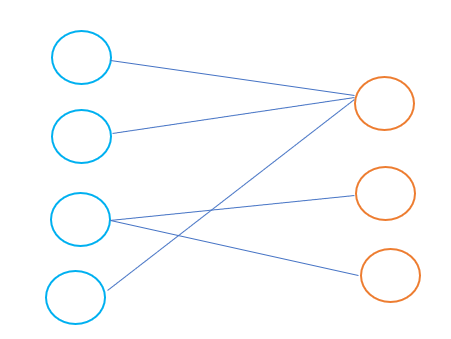
然后我们回到这个题目上来,这个题目求的是最大可出战人数,实际上就是在二分图中找到两个集合中的最大匹配数,这类问题我们称之为二分图最大匹配数问题
属于网络流经典题目之一,下面说明一下建图的过程
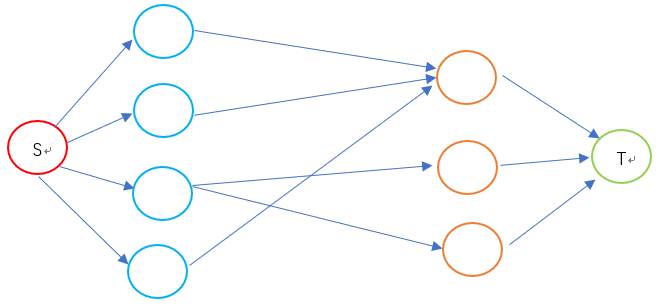
1)由源点向集合V中每个点建一条容量为1的边
2)对于V,K集合之间存在的边e,v 为V中的点,k为K中的点,我们建一条容量为1的边,方向为 v --> k
3)由K中每个点向汇点建一条容量为1的边
当我们将图建好了后,我们求这个图的最大流,这个最大流即为二分图最大匹配数,下面展示一下建成的图:(S代表源点,T代表汇点,蓝色的边代表容量为1的边)
#include<iostream>
#include<cstdio>
#include<algorithm>
#include<cstring>
#include<queue>
#include<string>
#include<fstream>
#include<vector>
#include<stack>
#include <map>
#include <iomanip>
#define bug cout << "**********" << endl
#define show(x,y) cout<<"["<<x<<","<<y<<"] "
//#define LOCAL = 1;
using namespace std;
typedef long long ll;
const int inf = 0x3f3f3f3f;
const ll mod = 1e6 + 3;
const int Max = 1e6 + 10;

struct Edge
{
    int to, next, flow;
}edge[Max << 1];;

int n, m, a, b, s, t;
int head[Max], tot;
int dis[Max];
int ans;
bool vis[Max];

void init()
{
    memset(head, -1, sizeof(head));tot = 0;
    ans = 0;
}

void add(int u, int v, int flow)
{
    edge[tot].to = v;
    edge[tot].flow = flow;
    edge[tot].next = head[u];
    head[u] = tot++;
}

bool bfs()
{
    memset(dis, -1, sizeof(dis));
    dis[s] = 0;
    queue<int>q;
    q.push(s);
    while (!q.empty())
    {
        int u = q.front();q.pop();
        for (int i = head[u]; i != -1;i = edge[i].next)
        {
            int v = edge[i].to;
            if (dis[v] == -1 && edge[i].flow > 0)
            {
                dis[v] = dis[u] + 1;
                if (v == t) return true;
                q.push(v);
            }
        }
    }
    return false;
}

int dfs(int u, int flow_in)
{
    if (u == t) return flow_in;
    int flow_out = 0;
    for (int i = head[u]; i != -1;i = edge[i].next)
    {
        int v = edge[i].to;
        if (dis[v] == dis[u] + 1 && edge[i].flow > 0)
        {
            int flow_part = dfs(v, min(flow_in, edge[i].flow));
            if (flow_part == 0) continue;
            flow_in -= flow_part;
            flow_out += flow_part;
            edge[i].flow -= flow_part;
            edge[i ^ 1].flow += flow_part;
            if (flow_in == 0)break;
        }
    }
    return flow_out;
}

int max_val()
{
    int sum = 0;
    while (bfs())
    {
        sum += dfs(s, inf);
    }
    return sum;
}

int main()
{
#ifdef LOCAL
    freopen("input.txt", "r", stdin);
    freopen("output.txt", "w", stdout);
#endif
    while (scanf("%d%d", &m, &n) != EOF)
    {
        init();
        s = 0, t = n + 1;
        for (int i = 1;i <= m;i++)
        {
            add(s, i, 1);add(i, s, 0);    //由源点向外籍飞行员建边
        }
        for (int i = m + 1; i <= n;i++)
        {
            add(i, t, 1);add(t, i, 0);
        }
        while (scanf("%d%d", &a, &b) != EOF && a != -1 && b != -1)
        {
            add(a, b, 1);add(b, a, 0);
        }
        printf("%d\n", max_val());
        for (int u = 1;u <= m;u++)
        {
            for (int i = head[u]; i != -1;i = edge[i].next)
            {
                if (edge[i].flow == 0 && edge[i].to != s && edge[i].to != t)
                {
                    printf("%d %d\n", u, edge[i].to);
                }
            }
        }
    }
    return 0;
}
最小费用最大流
这类题目相比于最大流问题新增了每天边单位流量的价格,问在最大流的情况下求出最小的费用。
这类题目和最大流很想,不过也有不小区别,对于这类问题,我们为每条边建的反边的价格是每天边的相反数,如图
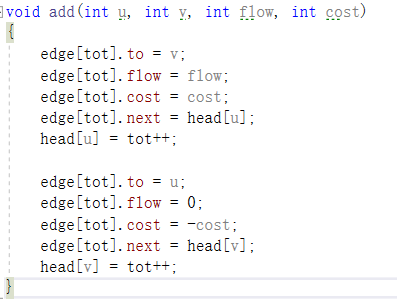
然后我们的算法也不再是Dinic算法了,而是用spfa或者dijkstra
#pragma GCC optimize(2)
#include<iostream>
#include<cstdio>
#include<algorithm>
#include<cstring>
#include<queue>
#include<string>
#include<fstream>
#include<vector>
#include<stack>
#include <map>
#include <iomanip>
#define bug cout << "**********" << endl
#define show(x,y) cout<<"["<<x<<","<<y<<"] "
#define LOCAL = 1;
using namespace std;
typedef long long ll;
const int inf = 0x3f3f3f3f;
const ll mod = 1e9 + 7;
const int Max = 5e3 + 10;

struct Edge
{
    int to, rev;                    //rev记录反向边
    int flow, cost;;
};

int n, m, k;
vector<Edge>edge[Max << 1];
int h[Max];                            //每个结点的势
int dis[Max];
int pre_node[Max], pre_edge[Max];    //前驱结点和对应边

void add(int u, int v, int flow, int cost)
{
    edge[u].push_back({ v,(int)edge[v].size(),flow,cost });

    edge[v].push_back({ u,(int)edge[u].size() - 1,0,-cost });
}

void min_cost_flow(int s, int t, int& min_cost, int& max_flow)
{
    fill(h + 1, h + 1 + n, 0);
    min_cost = max_flow = 0;
    int tot = inf;                            //源点流量无限
    while (tot > 0)
    {
        priority_queue<pair<int, int>, vector<pair<int, int> >, greater<pair<int, int> > >q;
        memset(dis, inf, sizeof(dis));
        dis[s] = 0;q.push({ 0,s });
        while (!q.empty())
        {
            int u = q.top().second;
            int dist = q.top().first;
            q.pop();
            if (dis[u] < dist)continue;        //当前的距离不是最近距离
            for (int i = 0;i < edge[u].size(); i++)
            {
                Edge &e = edge[u][i];
                if (edge[u][i].flow > 0 && dis[e.to] > dis[u] + e.cost + h[u] - h[e.to])
                {
                    dis[e.to] = dis[u] +e.cost + h[u] - h[e.to];
                    pre_node[e.to] = u;
                    pre_edge[e.to] = i;
                    q.push({ dis[e.to],e.to });
                }
            }
        }
        if (dis[t] == inf)break;            //无法增广了,就是找到答案了
        for (int i = 1;i <= n;i++) h[i] += dis[i];
        int flow = tot;                        //求这一增广路径的流量
        for (int i = t; i != s; i = pre_node[i])
            flow = min(flow, edge[pre_node[i]][pre_edge[i]].flow);
        for (int i = t; i != s; i = pre_node[i])
        {
            Edge& e = edge[pre_node[i]][pre_edge[i]];
            e.flow -= flow;
            edge[i][e.rev].flow += flow;
        }
        tot -= flow;
        max_flow += flow;
        min_cost += flow * h[t];
    }
}

int main()
{
#ifdef LOCAL
    //freopen("input.txt", "r", stdin);
    //freopen("output.txt", "w", stdout);
#endif
    int s, t;
    while (scanf("%d%d%d%d", &n, &m, &s, &t) != EOF)
    {
        for (int i = 1, u, v, flow, cost;i <= m;i++)
        {
            scanf("%d%d%d%d", &u, &v, &flow, &cost);
            add(u, v, flow, cost);
        }
        int min_cost, max_flow;
        min_cost_flow(s, t, min_cost, max_flow);
        printf("%d %d\n", max_flow, min_cost);
    }
    return 0;
}
#include<iostream>
#include<cstdio>
#include<algorithm>
#include<cstring>
#include<queue>
#include<string>
#include<fstream>
#include<vector>
#include<stack>
#include <map>
#include <iomanip>
#define bug cout << "**********" << endl
#define show(x,y) cout<<"["<<x<<","<<y<<"] "
//#define LOCAL = 1;
using namespace std;
typedef long long ll;
const int inf = 0x3f3f3f3f;
const ll mod = 1e9 + 7;
const int Max = 1e5 + 10;

struct Edge
{
    int to, next;
    int flow, cost;
}edge[Max << 1];

int n, m, s, t;
int head[Max], tot;
int dis[Max];
int pre[Max];            //记录增广路径此点的前一天边
bool vis[Max];

void init()
{
    memset(head, -1, sizeof(head));tot = 0;
}

void add(int u, int v, int flow, int cost)
{
    edge[tot].to = v;
    edge[tot].flow = flow;
    edge[tot].cost = cost;
    edge[tot].next = head[u];
    head[u] = tot++;

    edge[tot].to = u;
    edge[tot].flow = 0;
    edge[tot].cost = -cost;
    edge[tot].next = head[v];
    head[v] = tot++;
}

bool spfa(int s, int t)
{
    memset(dis, inf, sizeof(dis));
    memset(vis, 0, sizeof(vis));
    memset(pre, -1, sizeof(pre));

    queue<int>q;
    q.push(s);dis[s] = 0;vis[s] = true;

    while (!q.empty())
    {
        int u = q.front();q.pop();
        vis[u] = false;
        for (int i = head[u]; i != -1; i = edge[i].next)
        {
            int v = edge[i].to;
            if (edge[i].flow > 0 && dis[v] > dis[u] + edge[i].cost)
            {
                dis[v] = dis[u] + edge[i].cost;
                pre[v] = i;

                if (!vis[v])
                {
                    vis[v] = true;q.push(v);
                }
            }
        }
    }
    return pre[t] != -1;
}

void min_cost_max_flow(int s, int t, int& max_flow, int& min_cost)
{
    max_flow = 0;
    min_cost = 0;
    while (spfa(s, t))
    {
        int flow = inf;
        for (int i = pre[t]; i != -1; i = pre[edge[i ^ 1].to])    //沿增广路回溯edge[i^1]即为其反边
        {
            flow = min(flow, edge[i].flow);
        }
        for (int i = pre[t]; i != -1; i = pre[edge[i ^ 1].to])
        {
            edge[i].flow -= flow;
            edge[i ^ 1].flow += flow;
            min_cost += flow * edge[i].cost;
        }
        max_flow += flow;
    }
}

int main()
{
#ifdef LOCAL
    freopen("input.txt", "r", stdin);
    freopen("output.txt", "w", stdout);
#endif
    while (scanf("%d%d%d%d", &n, &m, &s, &t) != EOF)
    {
        init();
        for (int i = 1, u, v, flow, cost;i <= m;i++)
        {
            scanf("%d%d%d%d", &u, &v, &flow, &cost);
            add(u, v, flow, cost);
        }
        int max_flow = 0, min_cost = 0;
        min_cost_max_flow(s, t, max_flow, min_cost);
        printf("%d %d\n", max_flow, min_cost);
    }
    return 0;
}