
20191201
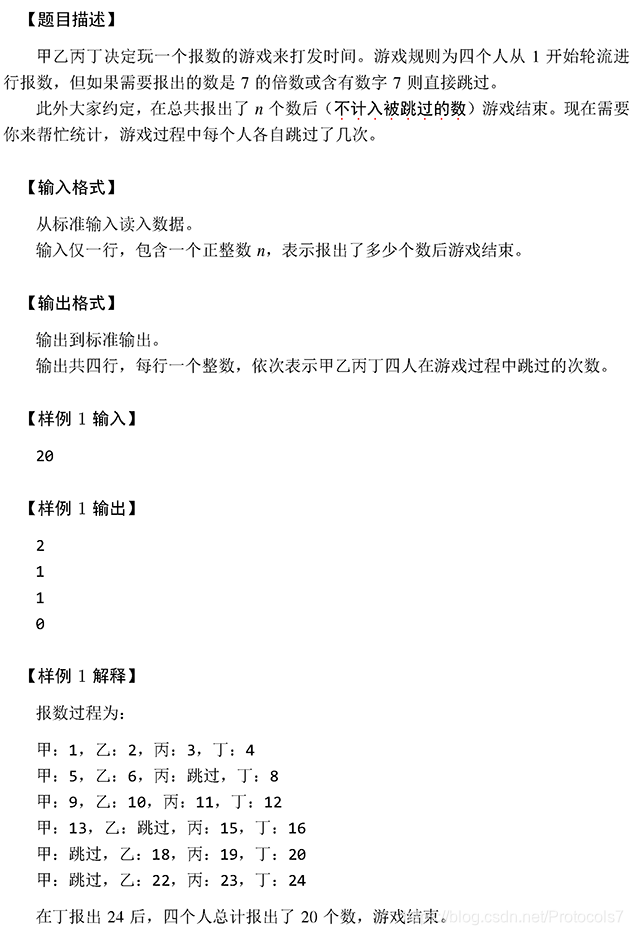
#include "iostream"
using namespace std;
bool is_seven(int n){
    if(n%7==0) return 1;
    while(n){
        if(n%10==7) return 1;
        n/=10;
    }
    return 0;
}
int main(int argc, char* argv[])
{
    int n;
    cin>>n;
    int now = 1;
    int num_a=0,num_b=0,num_c=0,num_d=0;
    int num = 1;
    while(n){
        switch(now){
            case 1:
                if(is_seven(num)){
                    num_a++;
                }else{
                    n--;
                }
                break;
            case 2:
                if(is_seven(num)){
                    num_b++;
                }else{
                    n--;
                }
                break;
            case 3:
                if(is_seven(num)){
                    num_c++;
                }else{
                    n--;
                }
                break;
            case 4:
                if(is_seven(num)){
                    num_d++;
                }else{
                    n--;
                }
                break;
        }
        now++;
        num++;
        if(now == 5) now =1;
    }
    cout<<num_a<<endl<<num_b<<endl<<num_c<<endl<<num_d;
	return 0;
}
20191202
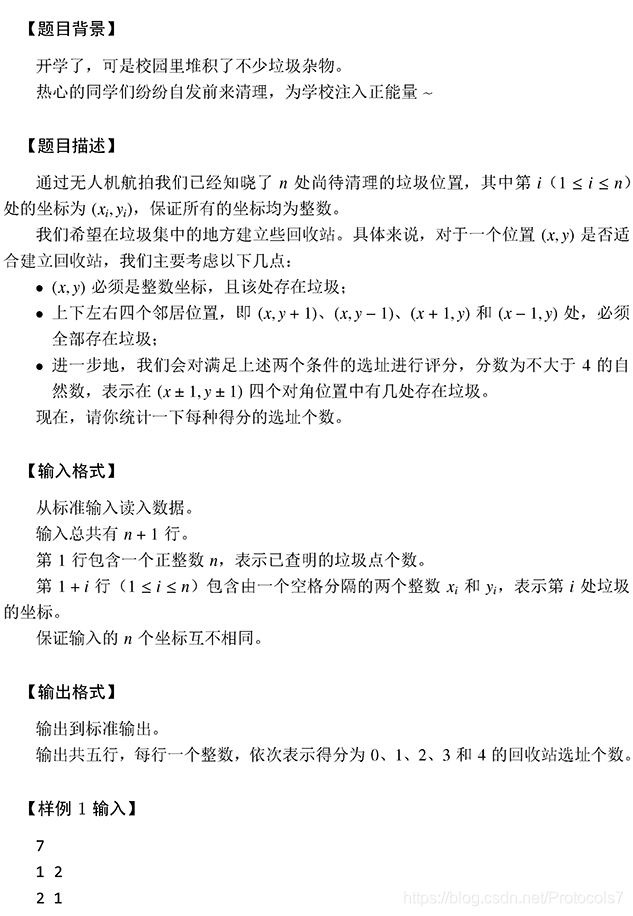

参考了https://blog.csdn.net/richenyunqi/article/details/103988931
#include <bits/stdc++.h>
using namespace std;
using LL = long long;
// 由于unordered_map是采用哈希实现的,对于系统的类型int, string等,都已经定义好了hash函数,
// 所以如果我们引入新的自定义类型的话,系统并不知道如何去计算我们引入的自定义类型的hash值,
// 所以我们就需要自己定义hash函数,告诉系统用这种方式去计算我们引入的自定义类型的hash值
struct arrayHash
{
//我试过return 0,也AC了,是不是用例中没产生冲突呢?
    LL operator()(const array<LL, 2> &p) const { return p[0] * 1e9 + p[1]; }
};

int main()
{
    /*
    用map存储整个棋盘的所有棋子
    @array<LL,2> 用一个二维数组表示棋子横纵坐标
    @array<LL,2> 用一个二维数组表示棋子以下信息:
    @@LL 表示该棋子上下左右相邻点个数
    @@LL 表示该棋子对角线相邻点个数
    @array_hash 数组做为key的哈希函数
    */
    unordered_map<array<LL, 2>, array<LL, 2>, arrayHash> um;
    LL n;
    cin >> n;
    while (n--)
    {
        array<LL, 2> p;
        cin >> p[0] >> p[1];
        um.insert({p, {0, 0}}); //存储当前棋子
        for (auto &elemnent : um)
        {
            auto &q = elemnent.first; //q是每个元素的别名
            if ((q[0] == p[0] and abs(q[1] - p[1]) == 1) or (q[1] == p[1] and abs(q[0] - p[0]) == 1))
            {
                um[p][0]++;
                um[q][0]++;
                //上下左右的棋子数目加一
            }
            else if (abs(q[0] - p[0]) == 1 and abs(q[1] - p[1]) == 1)
            {
                um[p][1]++;
                um[q][1]++;
                //斜对角棋子数目加一
            }
        }
    }
    array<LL, 5> ans{};
    for (auto &element : um)
    {
        auto &nums = element.second;
        if (nums[0] == 4)
        {
            ans[nums[1]]++;
        }
    }
    for (auto nums : ans)
    {
        cout << nums << endl;
    }
    return 0;
}
来源:CSDN
作者:古航
链接:https://blog.csdn.net/Protocols7/article/details/104105459