
问题
I have a table A which has primary key column a and it is forigen key to B table(Table B has primary key b and column a).Table B has also a primary key b which forigen key to C table and so on.
Now if I want to delete a row from Table A then it wont allow me because its dependent table B and table B is dependent on Table C.So I have to delete a row from C first then B and at last A manually
So can anybody please tell me if there is any way to delete directly without going to each table and checking if it has any dependencies or not and then deleting
回答1:
You Can Use Cascade Cascading Referential Integrity Constraints
Update: you should enable Cascading Referential Integrity Constraints of Table A (PK) from Table B where ID of A is foreign Key and similarly of PK of Table B From Table C Where ID of B is foreign Key
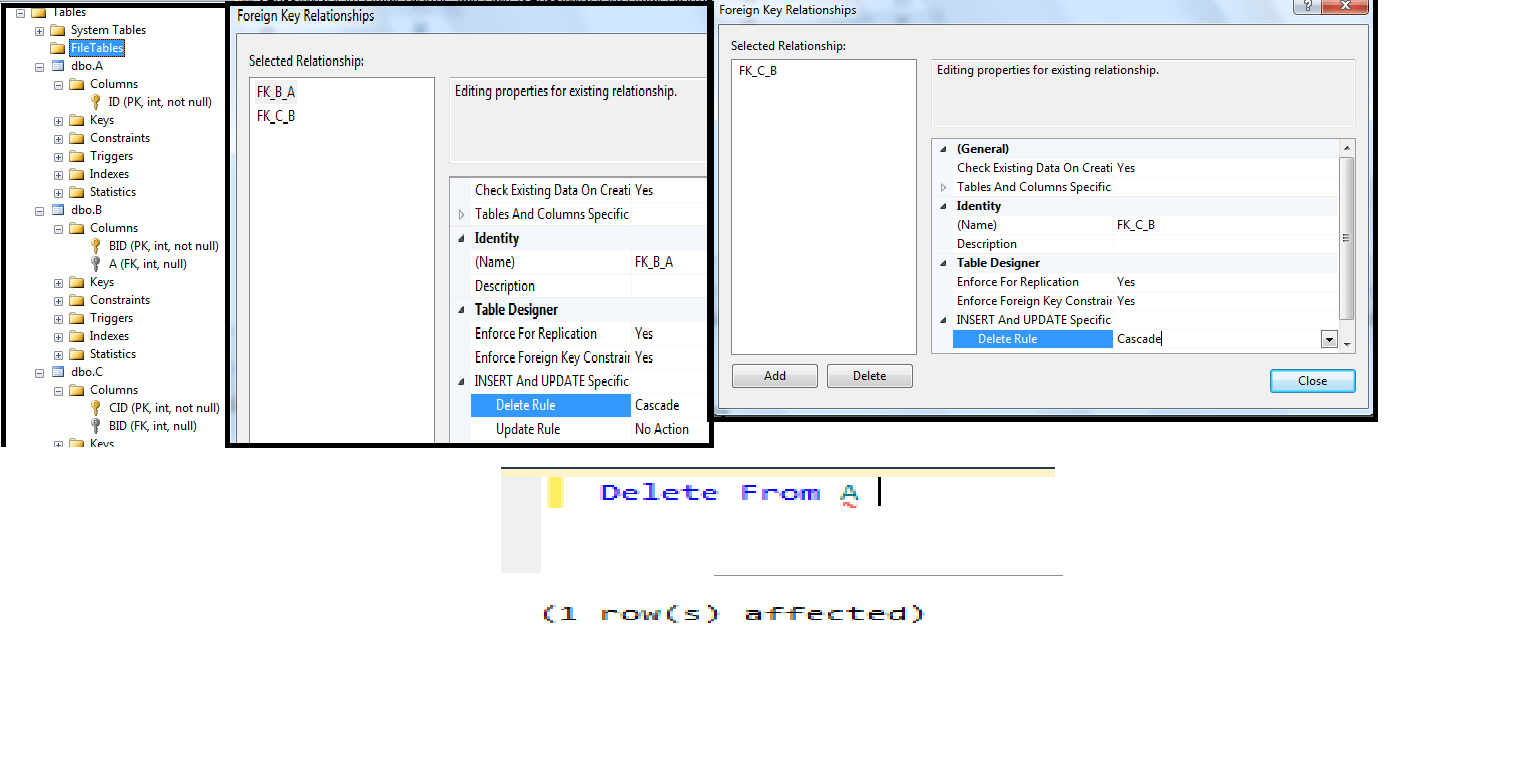
MSDN LIBRARY
CODE PROJECT ARTICALE
Very Nice Article BLOG.SQL AUTHORITY
回答2:
If you're not allowed to modify the tables, you can take a look at the EXISTS operator.
It will allow you to delete rows from a table only if the query inside the EXISTS return at least 1 result. You can use it to check dependencies.
You can write 3 queries:
DELETE C c
WHERE EXISTS (SELECT 1
              FROM B b
              WHERE c.b = b.b
              AND EXISTS (SELECT 1
                          FROM A a
                          WHERE a.a = b.a
                          AND ... ));
DELETE B b
WHERE EXISTS (SELECT 1
              FROM A a
              WHERE a.a = b.a
              AND ...);

DELETE A a
WHERE ...
The first one will take care of record in C that references records in B that references records in A that you want to delete.
Then you can remove records from B since there is no more dependencies in C.
Finally, you're able to delete records from A using the same logic.
回答3:
The term you're looking for is 'cascade' - you need cascading deletes. You can enable them, as explained here: How do I use cascade delete with SQL Server?
回答4:
You could use cascading referential integrity, see this question. However, beware, too much cascading RI and you can do a lot of damage without realising it!
回答5:
As others have already pointed out, cascade delete is what you are looking for. In one of the comments, you have mentioned that you do not know the dependencies. Here is a script that will list the dependencies
SELECT Db_name()                                   referencing_database_name,
       Object_name (referencing_id)                referencing_entity_name,
       Isnull(referenced_schema_name, 'dbo')       referenced_schema_name,
       referenced_entity_name,
       ao.type_desc                                referenced_entity_type,
       Isnull(referenced_database_name, Db_name()) referenced_database_name
FROM   sys.sql_expression_dependencies sed
       JOIN sys.all_objects ao
         ON sed.referenced_entity_name = ao.name
WHERE ao.type_desc = 'USER_TABLE'
回答6:
The automatic deletions depend on how you defined the relationships between the tables.
If you get an error when you try to delete a row in a master table, that's because you didn't specify an special action in the relationships for deletion.
What I mean is changing the ON DELETE and ON UPDATE options in the FK. This allows to specify what happens with the child rows when you delete or update the row in the main table. For example, the ON DELETE CASCADE option would do exactly what you want.
For example:
CREATE TABLE Sales.TempSalesReason (
  TempID int NOT NULL, Name nvarchar(50
),
CONSTRAINT PK_TempSales PRIMARY KEY NONCLUSTERED (TempID),
CONSTRAINT FK_TempSales_SalesReason FOREIGN KEY (TempID)
  REFERENCES Sales.SalesReason (SalesReasonID)
  ON DELETE CASCADE
  ON UPDATE CASCADE
)
would make that, when you delete or modify a row in the main table, the row is also modified or deleted on the child table.
Relevant docs:
Create Foreign Key Relationships
Cascading Referential Integrity Constraints
回答7:
There is a stored procedure 'sp_fkeys' which will give all foreign keys for a specific table
exec sp_fkeys 'My_Table'
So you could save the output to temp table and then in cursor you will delete all rows that have any dependency. If any nested table have dependencies too you will do the same but for the nested table (recursion)
来源:https://stackoverflow.com/questions/28317894/how-to-delete-all-dependent-rows